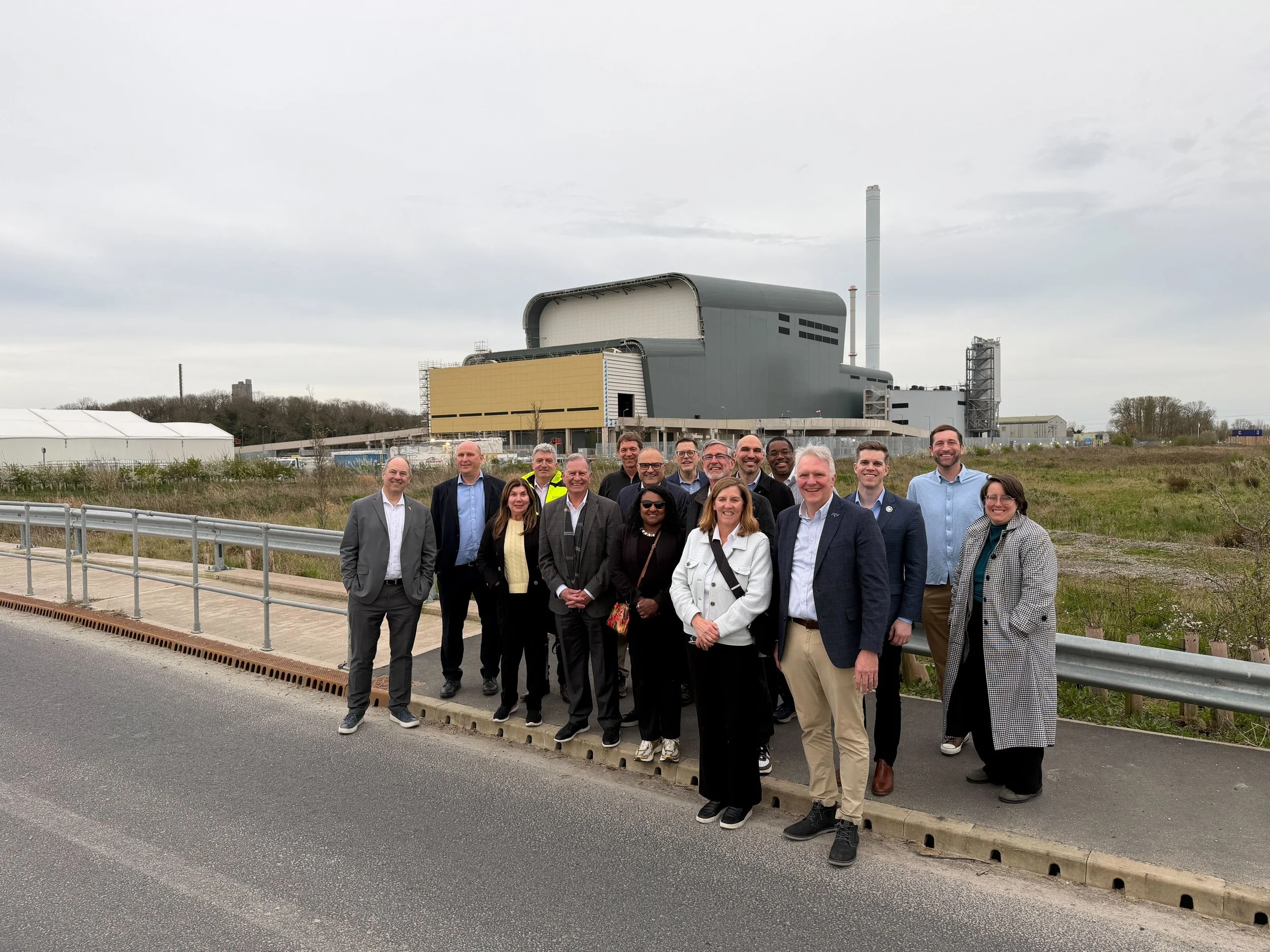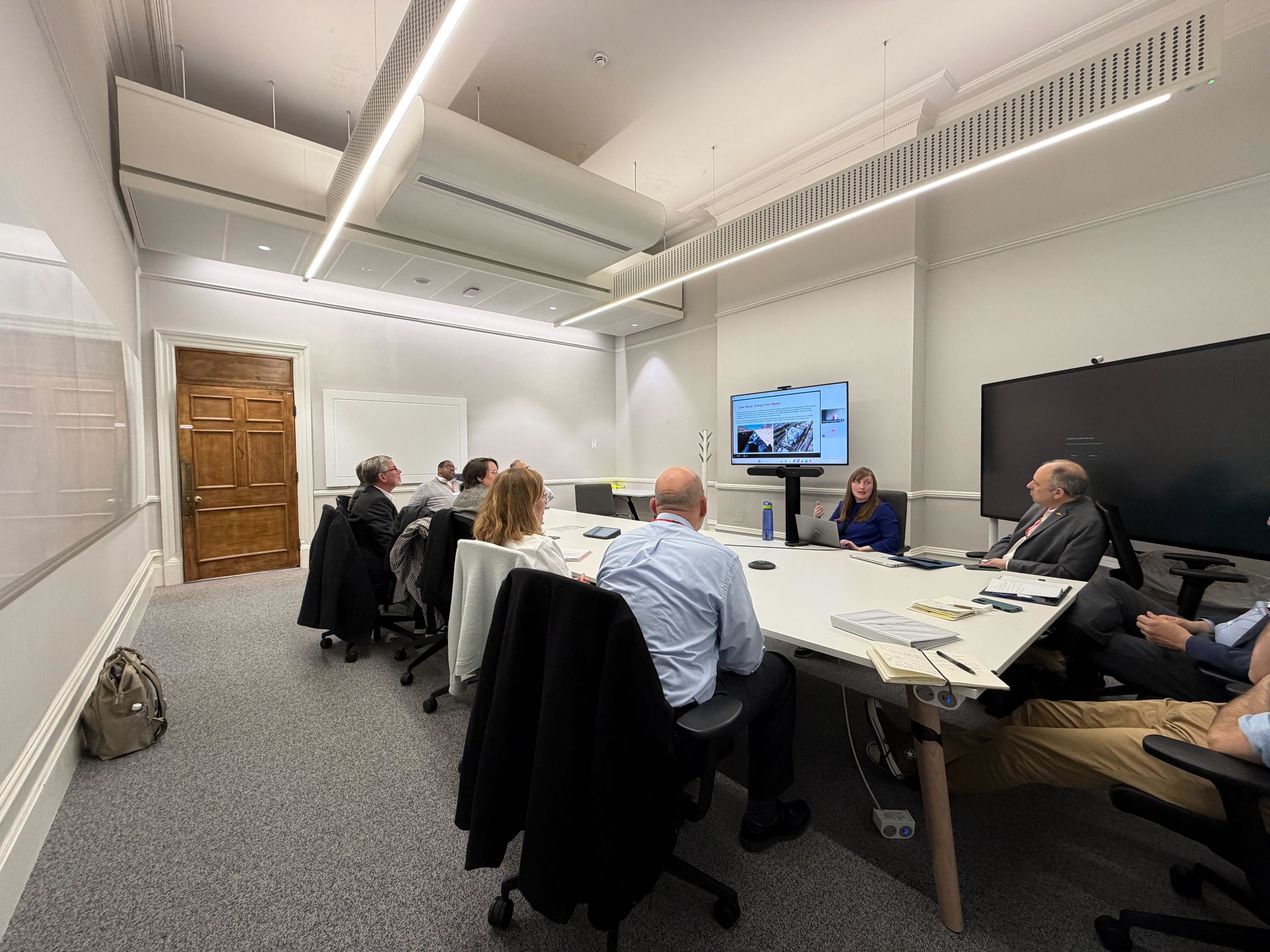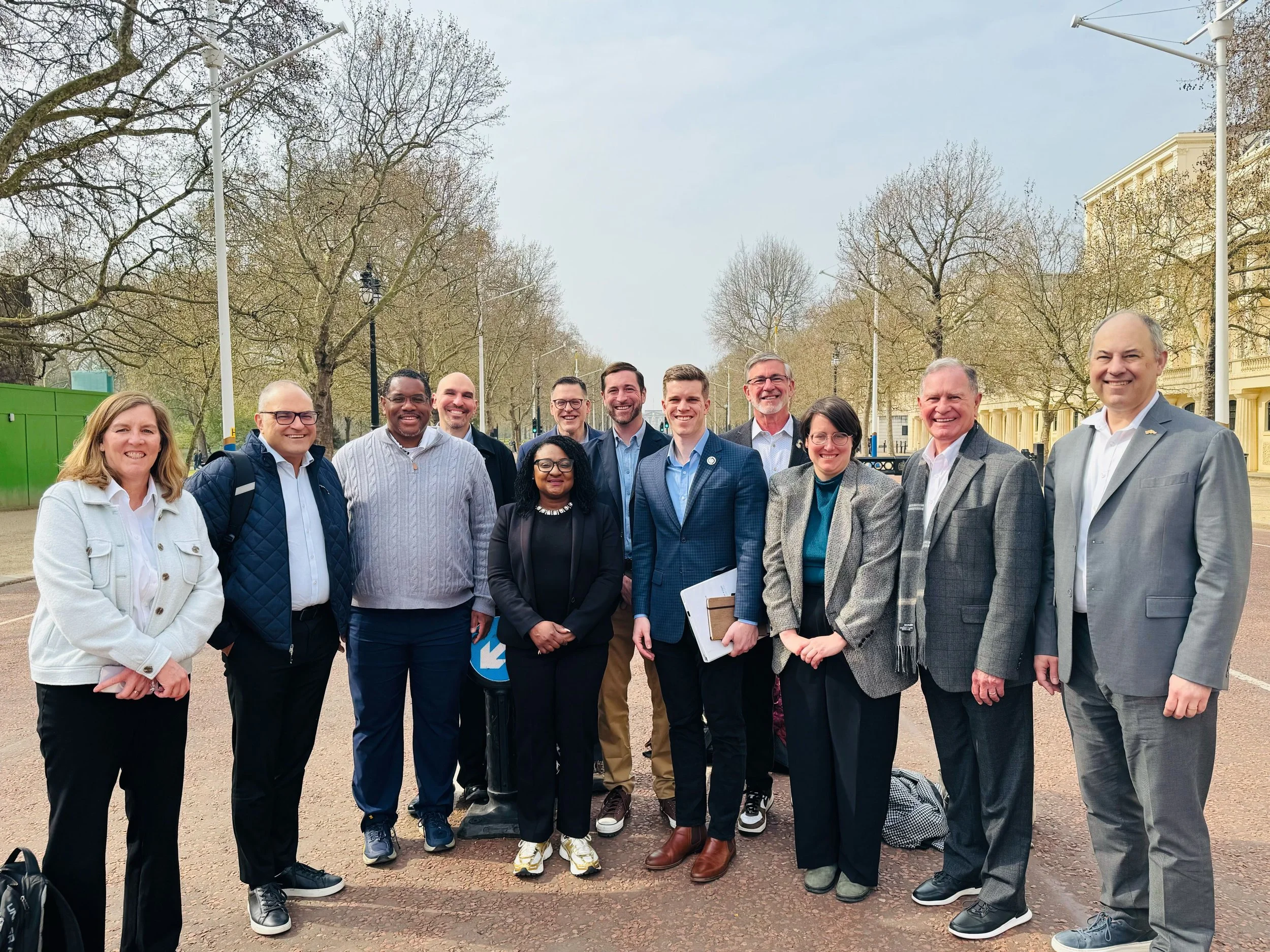
PCFO convened a delegation of Ohio mayors and local leaders to spend a week with UK partners and counterparts exchanging best practices in clean energy policy, exploring innovative climate solutions, and strengthening opportunities for collaboration.
Written by PCFO Director of Community Solutions Nat Ziegler.
Last month, PCFO had the incredible opportunity to co-lead a delegation of Ohio elected officials to the United Kingdom, facilitating international dialogue about the role of local governments in planning for and implementing climate action. Global increases in greenhouse gas emissions that have produced the climate crisis we all face have inspired ambitious decarbonization targets around the UK and here in the States, where emissions reductions targets shape plans, policies, and projects. We compared notes on local action to meet this moment in a series of briefings, site visits, and workshops with local government counterparts in the UK. We traveled with the following elected officials from PCFO member communities:
Mayor Steve Patterson, City of Athens
Mayor Sharetta Smith, City of Lima
Mayor Kirsten Gail, City of Euclid
Mayor Jack Bradley, City of Lorain
Cuyahoga County Executive, Chris Ronayne
Commissioner Matt Joseph, City of Dayton
The trip was made possible through the partnership and support of fellow travelers with the George Gund Foundation (John Mitterholzer, Program Director of Climate and Environmental Justice and Treye Johnson, Program Director of Economic Justice and Community Power) and the British Consulate General Chicago (Richard Hyde, General Consul, and Mike Fourcher, Policy Advisor). Our colleague Alyssa Johnson, PCFO’s Director of Programs and Partnerships and experienced international delegation traveler, organized and convened the trip for us. We are grateful for the full-team effort.
Some highlights of the trip, inspiration for our work here in Ohio, and key thematic takeaways included:
Revitalizing industrial heartlands and portside cities with sustainability and the green economy:
The United Kingdom’s national and local governments clearly believe in climate action as an economic development tool. Rather than conceptualizing clean energy as another wave of deindustrialization to hollow out local economies, the UK’s leaders embrace the transition from fossil fuels to low-carbon energy generation sources as a tool for growth. This is evident through national and local policy commitments, planning documents and targets for both economic growth and emissions reductions that are explicitly aligned, and the place-based approach to national policy goals and investment. More on all of that will follow, but to start, the UK’s industrial heartlands of Liverpool and Manchester existing technological progress have led to some projects that are really exciting, such as:
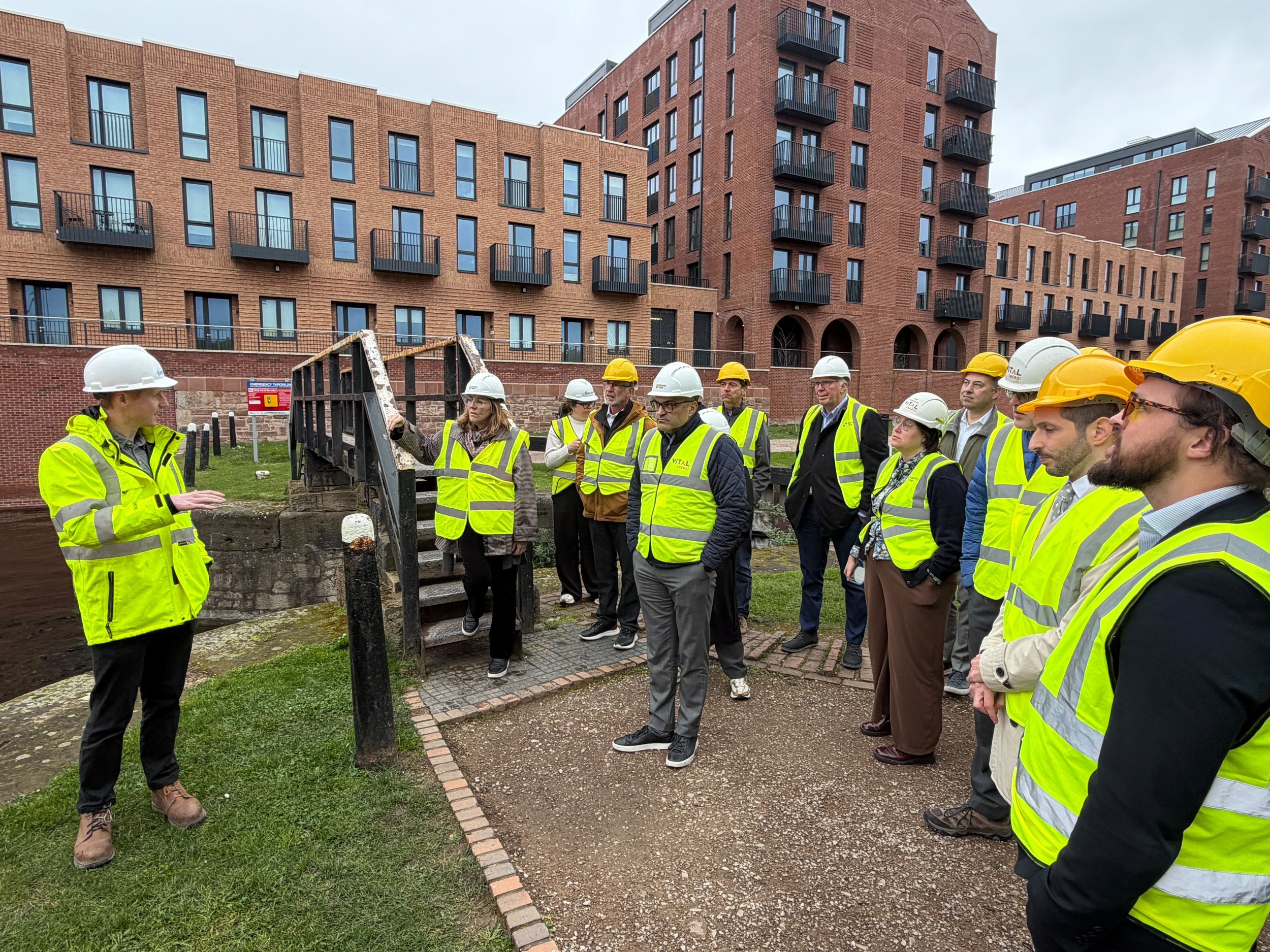
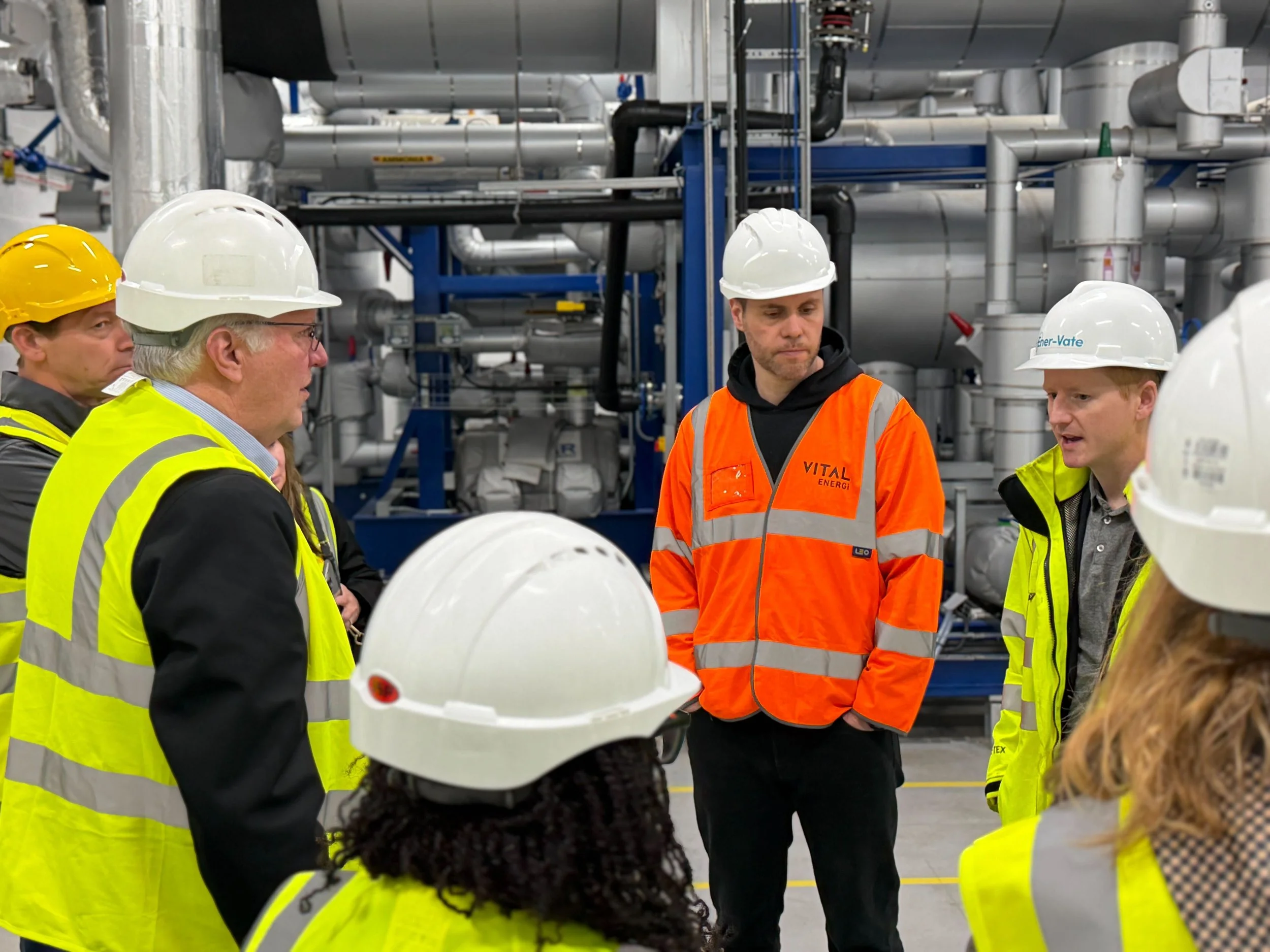
The Mersey Heat Energy Centre, a district heating network utilizing heat from Liverpool’s canals and two of the country’s largest water-source heat pumps to provide space and hot-water heating for new construction and adaptive reuse projects in a revitalizing city neighborhood;
The new Hill Dickinson Stadium, where Premier League club Everton plays in Liverpool, and where the bar is being raised for sustainability in sport. Facilities management and engineers built and now maintain the stadium to optimize energy use from lighting and chillers, and some of the stadium’s power comes from solar and battery storage.
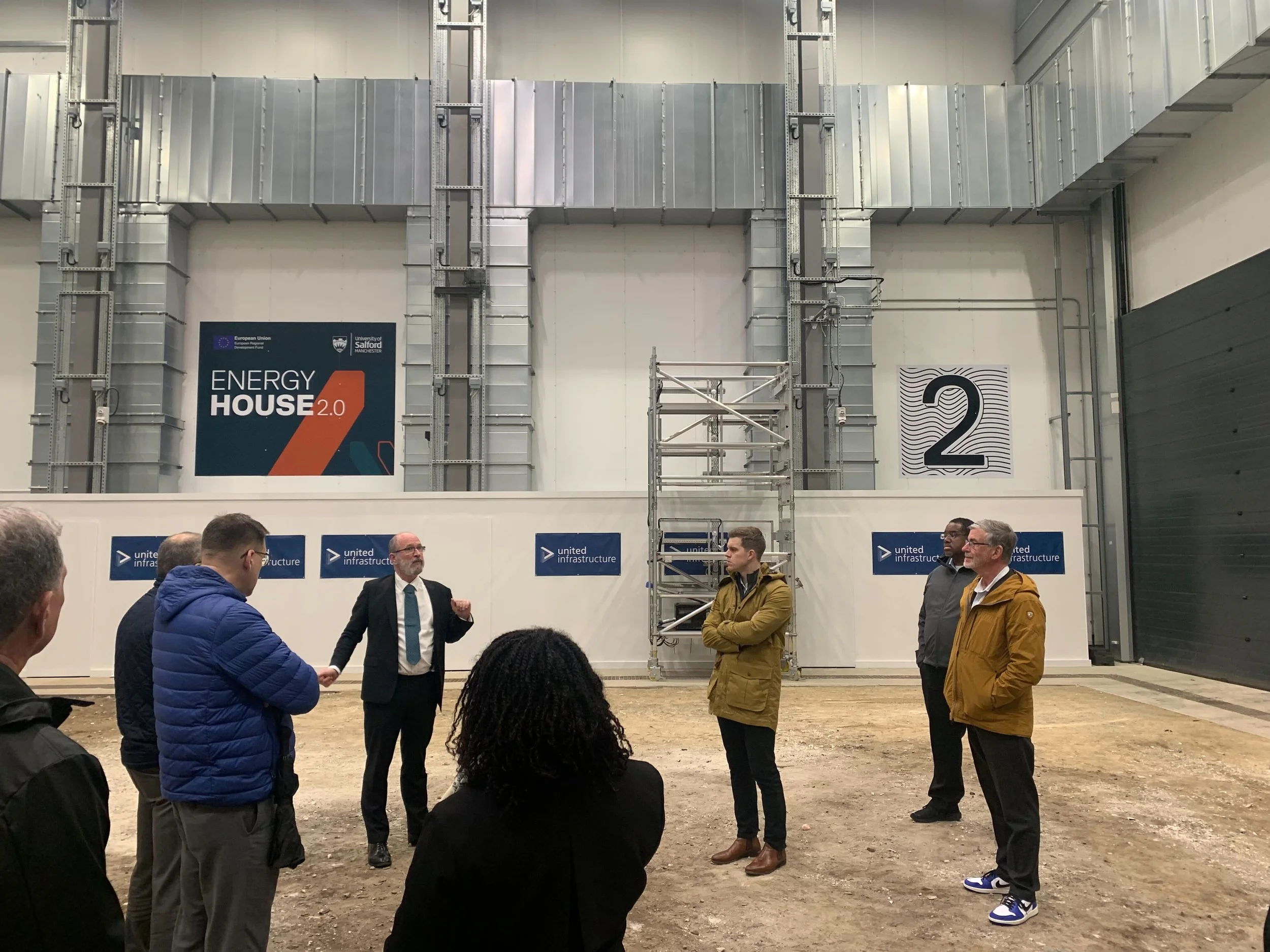
The Energy House 2.0 at the University of Salford in Greater Manchester, a laboratory for applying building performance research to advance deployment of new building technology for both retrofits and new construction in the UK’s residential sector.
Across industrial projects in Ellesmere Port, Greater Manchester, and Liverpool, leaders and developers are bought into the future of hydrogen as a replacement for current gas supply and distribution networks.
The effect of seeing these exciting decarbonization projects in the UK’s industrial heartland is best summed up by City of Dayton Commissioner Matt Joseph, who said:
“Seeing clean power-producing technologies already up and running was informative and motivating. If cities like Liverpool and Manchester, with industrial roots like our cities in Ohio, are able to take advantage of clean and affordable energy, we can do it, too.”
The importance of strategic partnerships and regional coordination:
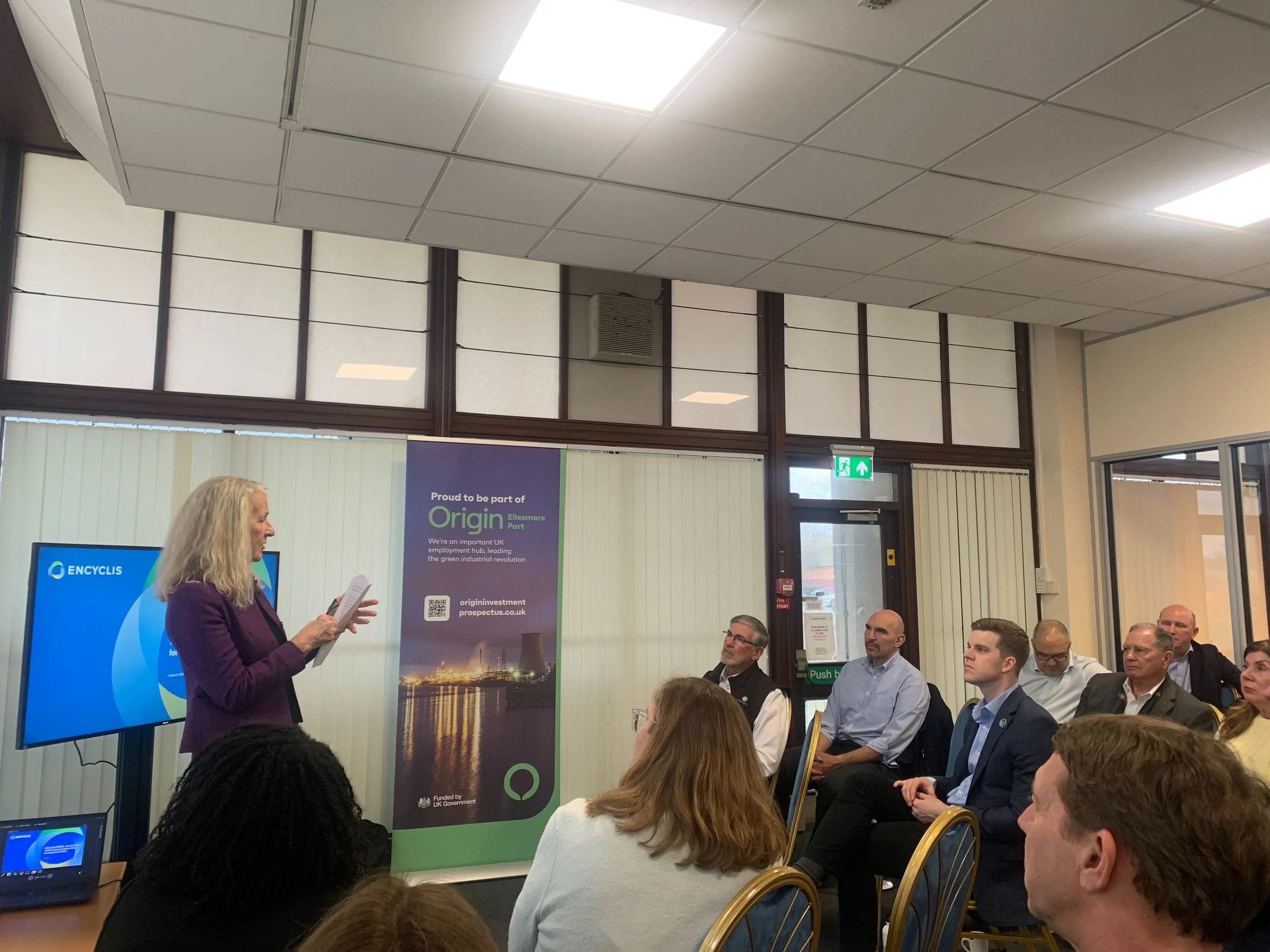
At the national, regional, and hyperlocal levels in the UK, public-sector plans and regulations drive investment by creating market certainty and facilitating meaningful public-private partnerships. Leaders from Cheshire West and Chester Council shared with us that their public sector leadership roles enabled facilitation and convening of business partners in the region to shape a new identity. This new identity, called “Origin,” pairs Council’s commitment to reaching net-zero with a bold goal to lead the UK’s green industrial revolution. Origin’s goals are guided and bolstered by public-private sector planning led by Net Zero North West, an entity that reminded me of the power of chambers of commerce in the States to bring together key players in inspiring and realizing industrial decarbonization and the promise of the green economy. The public sector has really committed to revitalization driven by sustainability and the imperatives of the climate crisis – Cheshire West and Chester Council has a staffer whose responsibilities are chartered in an impressive title, “Director for Transport, Highways, Infrastructure, and Climate Change.” This concerned local public and private investment has already produced real results – the highest emitting area of Ellesmere Port has seen the highest rate of emissions reductions to date, largely thanks to this industrial decarbonization.
Local alignment with national strategy and investment:
Local projects in the UK are place-based approaches to national commitments (via policies, plans, and financial investment) in decarbonization. National strategies are laid out in impressive planning documents like the UK’s Modern Industrial Strategy, including the clean energy sector specifically; Clean Power 2030, the Clean Energy Jobs Plan, and most recently the Warm Homes Plan. The place-based approach to implementing these plans is realized in a subsequent, more locally-driven level of planning – local growth plans, which mayoral strategic authorities create to generate a pipeline of investment-ready projects. These local projects can utilize national investment from sources like the Green Heat Network Fund, which exists to stand up new and existing heat networks like the Mersey Heat Energy Centre in accordance with national heat network goals. Our delegation of Ohioans reflected that we could benefit from heat networks that leverage waste heat from wastewater treatment plants and industrial users back home, but that we would need broader levels of governmental investment and policy incentives for development like in the UK to make this happen. (The potential is there, though, with biogas projects already up and running in Ohio!)
While national plans provide the highest level of policy and market certainty, the local growth plans that align with them drive tangible local progress. Local leaders from the Greater Manchester Combined Authority explained the creation and strong buy-in and commitment to realizing the 2025-2035 Strategic Plan. The comprehensive plan combines ambitious economic development and growth-oriented goals with climate and net-zero by 2038 commitments embedded strategically throughout. Similarly, the Liverpool City Region Combined Authority Growth Plan explicitly includes net-zero by 2035 goals, and envisions the green economy and increased clean energy jobs as a byproduct of meeting those goals.
Bonding and follow-up momentum: What’s next?
The bold commitments to local climate action and future-oriented strategic planning that we saw in the UK’s industrial heartland energized our delegation. The shared experience we had traveling from London to England’s Northwest, and all of the conversations and ideating along the way, have seeded a really potent cohort of local leaders here in Ohio. Commissioner Matt Joseph again put it best, reflecting that “Getting to know other advocates for clean and affordable energy production in cities and organizations across the state will be useful as we all look to build partnerships to get through this energy transition in the best way possible.”